

The S&P 500 had a strong week, gaining 2.51% and ending a four-week losing streak despite mixed economic data and news. Inflation is still running hot. The Consumer Price Index (CPI) rose 0.4% in October, and core prices, which exclude food and energy, rose 0.3% for the third month in a row. The Bureau of Labor Statistics (BLS) couldn't publish a year-over-year rate this month because last year's government shutdown kept it from collecting October 2025 data, leaving nothing to compare against. Going in, economists expected the annual rate to be about 4.0%, up from 3.7% in September, and the Cleveland Fed's estimate for November is 3.94%. Wholesale prices, measured by the Producer Price Index (PPI), are up 6.5% from a year ago, the highest since November 2022. That matters because wholesale inflation can point to upstream price increases that haven't reached consumers yet, and it puts a drag on corporate profits, which can weigh on stock prices.
With the job market strong, the Fed has room to focus on inflation and is expected to raise rates at each of its next three meetings. Raising rates is how the Fed cools an overheated economy. Higher rates make mortgages and car loans less affordable, so people spend less, and that takes pressure off prices. The 10-year Treasury yield, a benchmark for mortgages and many other long-term loans, is back above 5%. Housing is already slowing, with existing home sales down 5.5% in October. The Fed's monetary policy works best when inflation is driven by fast-rising consumer spending and wages. It's unclear how much the Fed can do when a primary source of inflation is high energy prices tied to the war in Iran.
Nvidia made headlines this week when co-founder Jensen Huang stepped down as CEO after leading the company for 33 years. He resigned following reports of extramarital affairs, including with Nvidia employees, one of whom reported directly to him, and with a woman suspected of being a Chinese spy. Nvidia's chips underpin much of the artificial intelligence industry, and AI-related stocks have driven most of the S&P 500's gains this year. The technology sector has grown to about 40% of the S&P 500, and Nvidia, an important U.S. company, makes up roughly 7% of the index by itself. A 20% drop in Nvidia alone would pull the index down more than 1%. This week's Nvidia news highlights one reason I don't recommend individual stocks. It's hard to know what someone in upper management might be doing that could affect a company's earnings and its stock price. People also often underestimate how much single-stock risk they may already have in a seemingly diversified portfolio that also holds index funds.
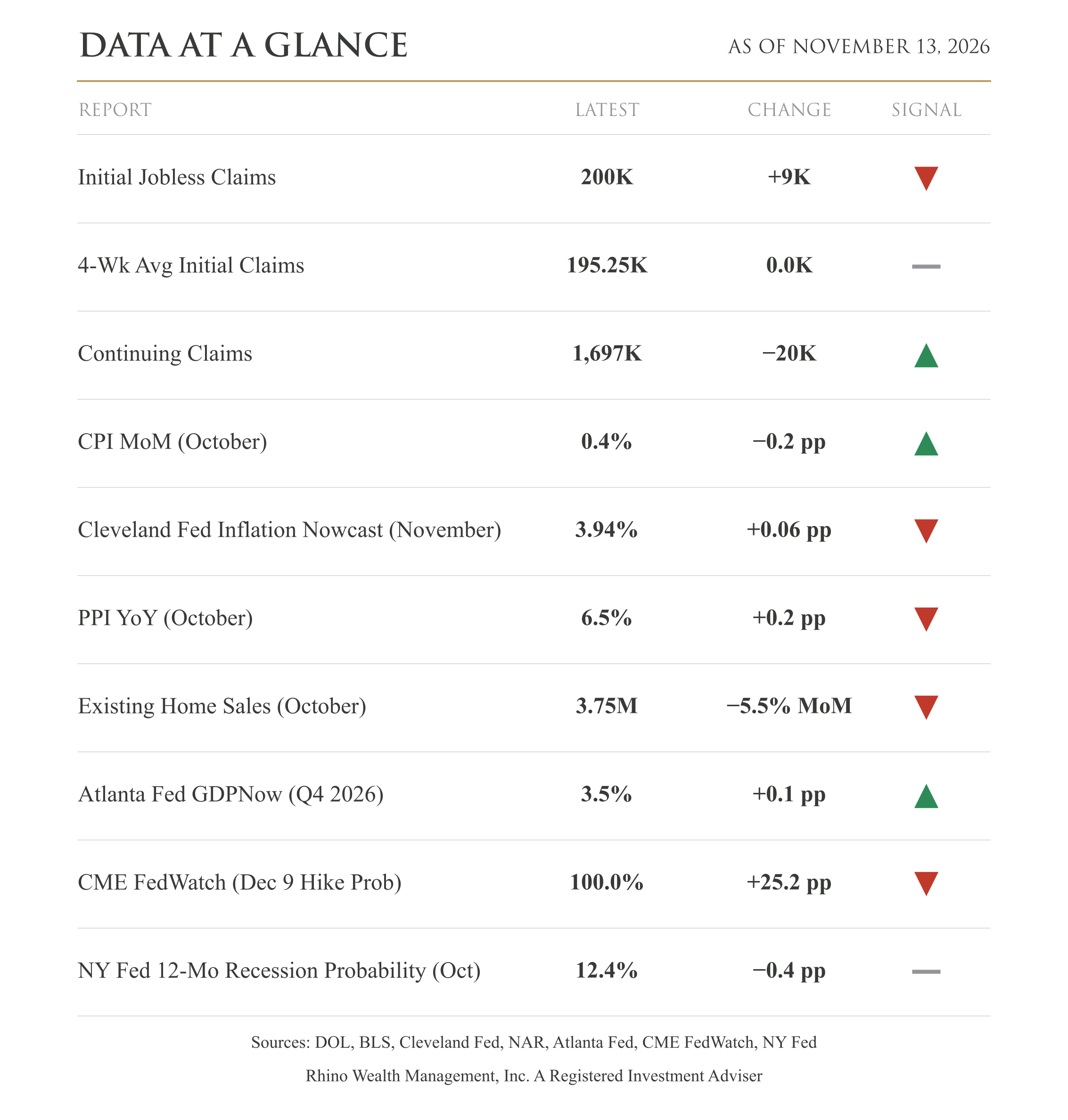
Inflation pressure is building, and the market now treats a December rate hike as a near certainty.
The job market is holding firm. Initial jobless claims ticked up to 200,000 but are still low by historical standards, and fewer people are drawing ongoing benefits.
Growth is still tracking well above average this quarter. Housing is the exception: existing home sales fell 5.5% in October, a sign that higher rates are starting to bite.
Consumer prices rose 0.4% in October. That’s slower than September but faster than expected. Wholesale prices are climbing faster, and early estimates point to inflation drifting higher in November.
Markets now put the odds of a December hike at 100%, up from about 75% a week ago. I think the story is the same as last week, only louder: rates are likely heading higher and staying there, while recession risk remains low.
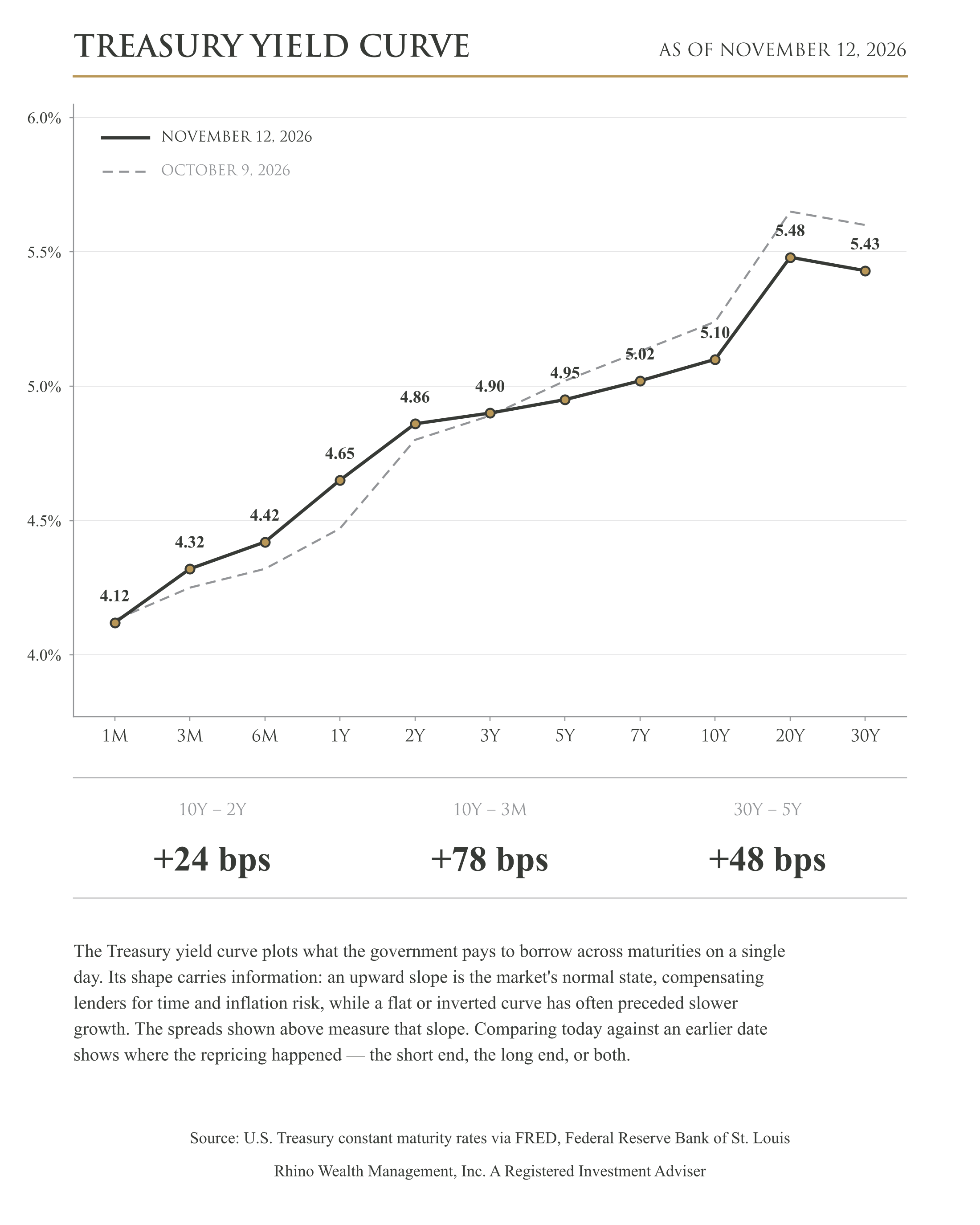
Long-term rates spent most of the past month drifting lower, as investors sold AI stocks and moved into the safety of Treasuries. This week, that relief faded. A hotter-than-expected inflation report revived the idea that the Fed isn't finished raising rates. Yields jumped across the board, and the 10-year moved back above 5%. Short-term rates led the way, with the 2-year posting its biggest one-day jump in more than a year and a half. That leaves a flatter curve than a month ago. The bond market is now pricing in a Fed that stays tight, even as long-term investors grow more cautious about growth.
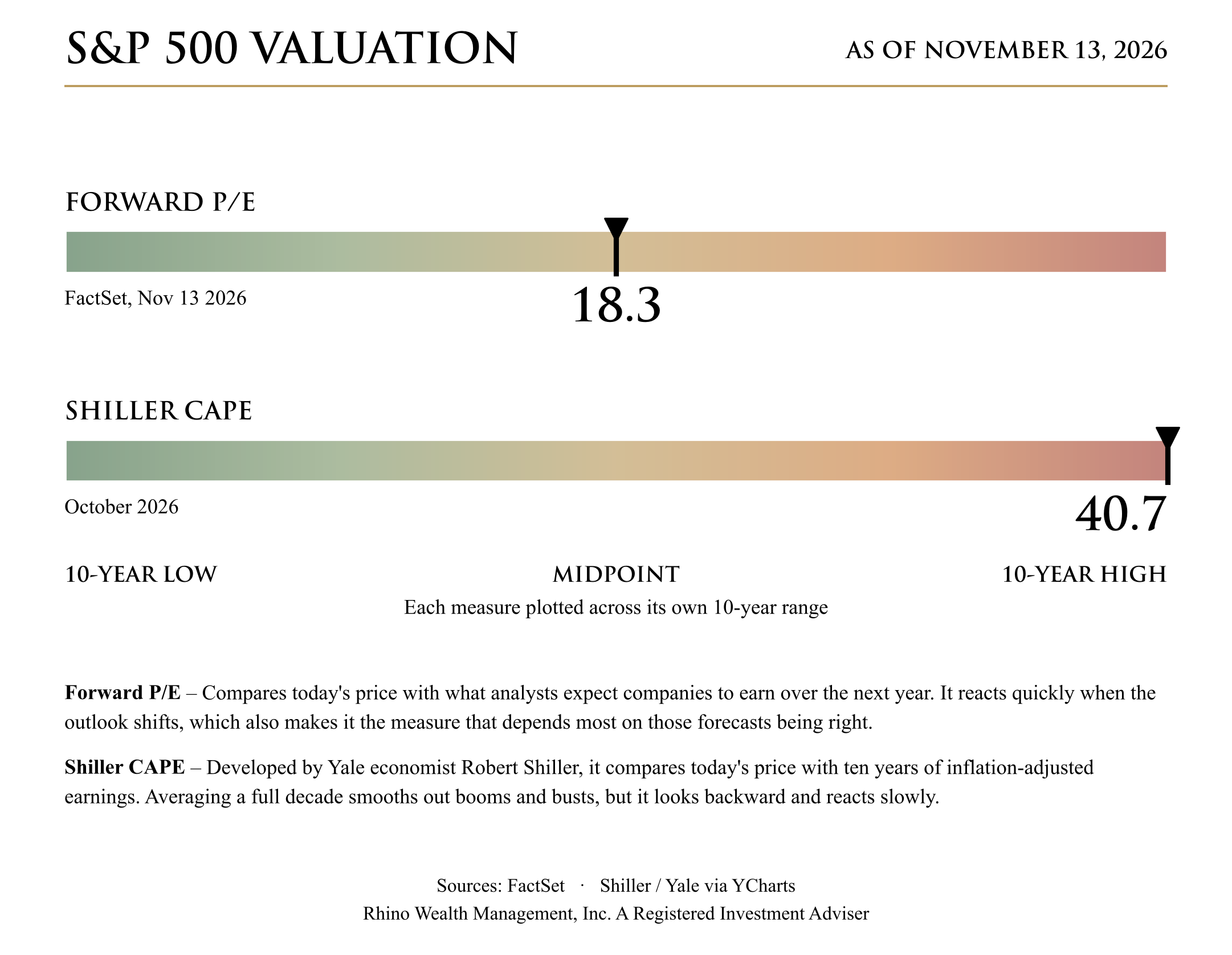
By one measure, stocks still look cheap. The forward P/E compares today's price with what companies are expected to earn over the next year. It rose to 18.3 this week from 17.7, but it's still below its 10-year average of 19.1 and the 19.0 it hit at the end of September. Since then, stock prices have been roughly flat while earnings estimates have kept climbing.
The Shiller CAPE compares today's price with the last ten years of earnings instead, and by that measure the market is the most expensive it's been in a decade. Both readings are right. They disagree because this year's earnings have been exceptional, led by energy companies and chipmakers. S&P 500 earnings are on pace to grow 33% in 2026, and analysts expect growth to slow to about 16% next year. If it slows more than that, the market won't look so cheap after all.
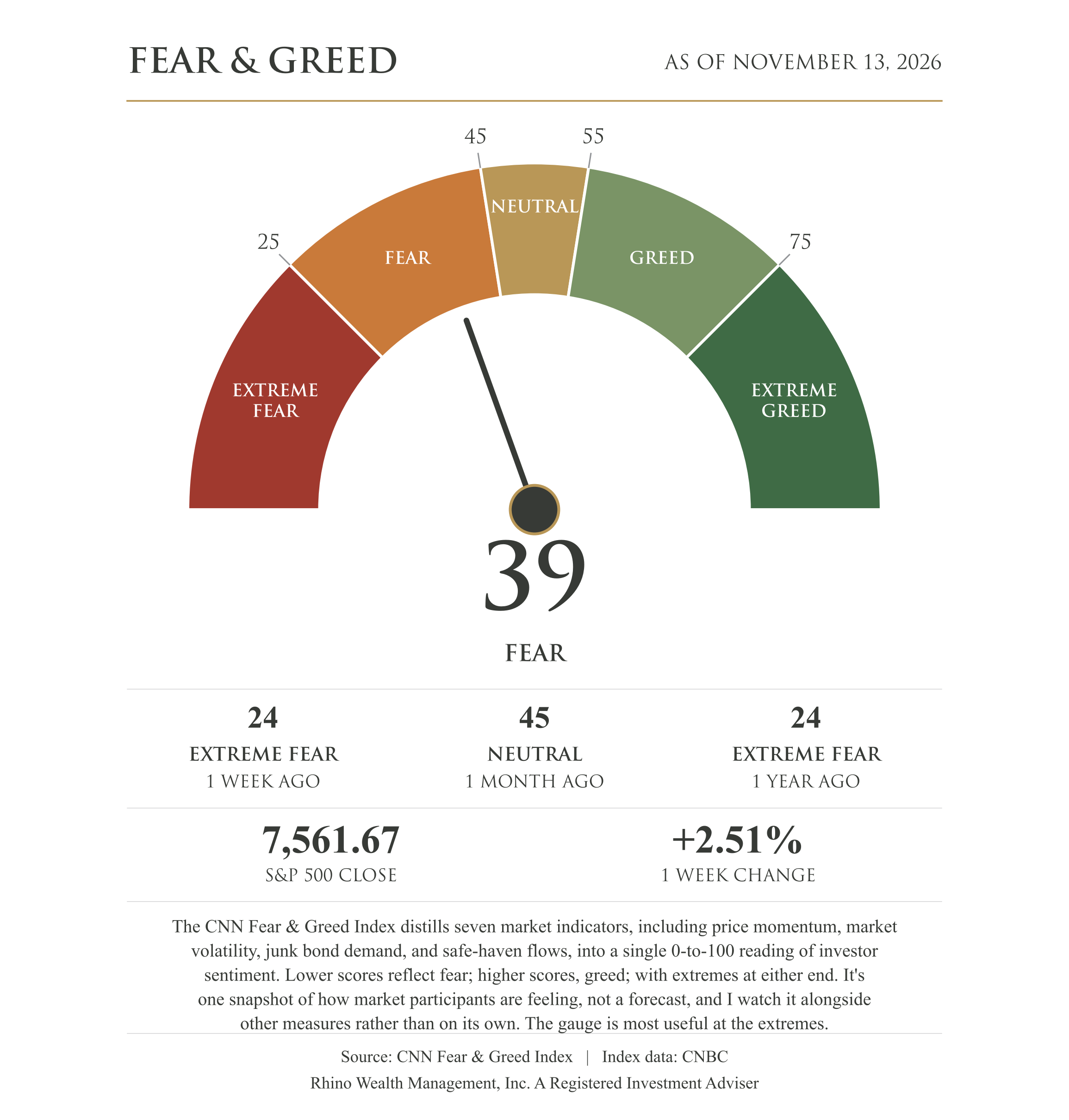
Sentiment is coming back, but more slowly than prices. A month ago the CNN Fear & Greed Index read 45, at the edge of neutral. Last week it fell to 24, in extreme fear. This week it rose to 39, which is still in fear territory. The S&P 500 gained 2.5% for the week which made up most of last week’s 2.7% drop. Prices have recovered, but investor confidence hasn’t caught up.
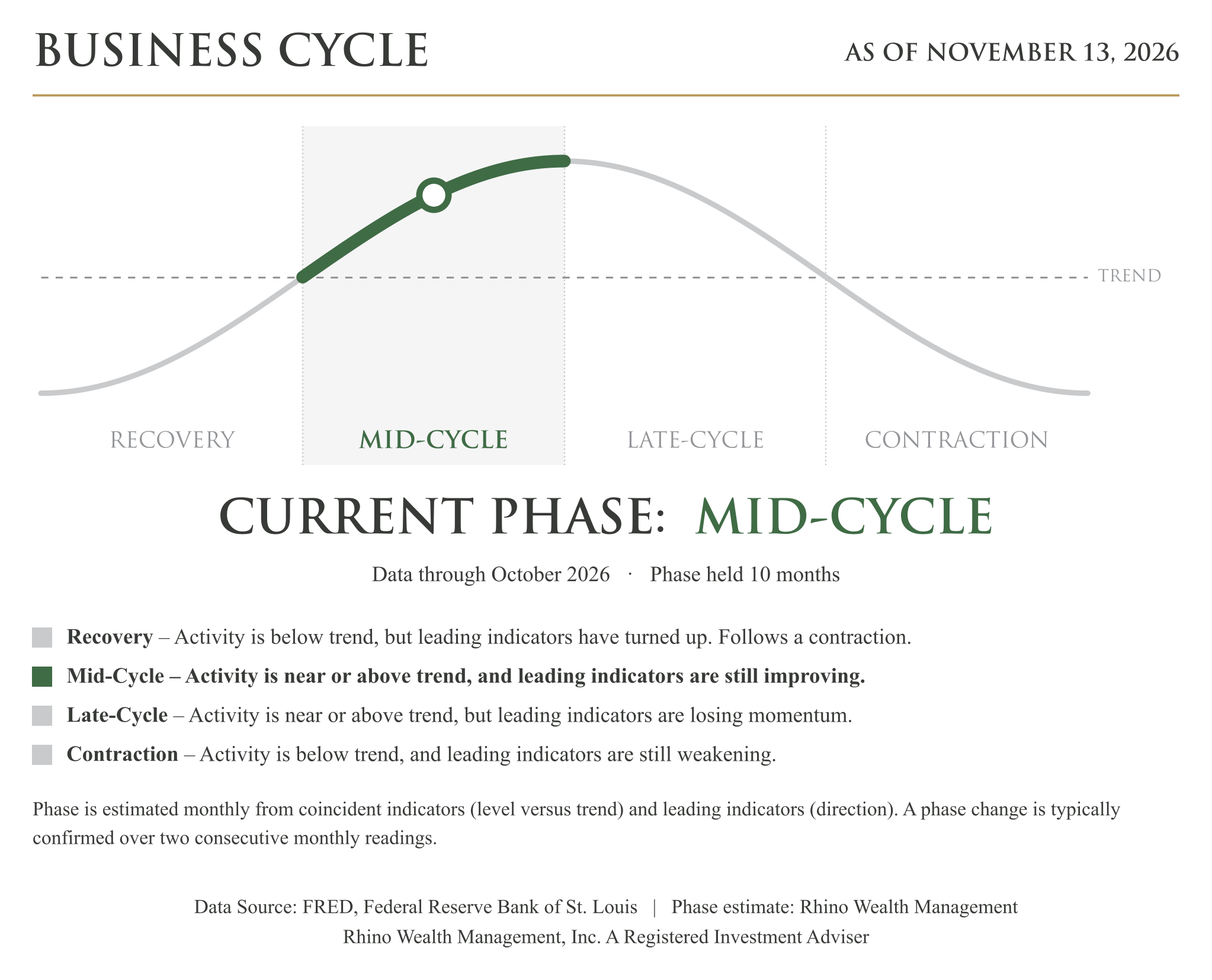
My business cycle model still reads mid-cycle, where it's been since January. The economy is growing at roughly its normal pace, and most of the indicators that tend to move ahead of it are still pointing up. Orders for business equipment are the strongest they've been relative to the past decade, factory workweeks are longer than usual, and layoffs are at their lowest level of the past year. Lenders also aren't charging investment-grade companies much extra interest. In October, though, that improvement nearly stalled. Building permits are soft, household income after inflation is growing more slowly than usual, and the extra yield on junk bonds has risen about half a percentage point since August. None of that is a warning sign yet: jobless claims show no sign of turning and stocks are above their 200-day average. The model would move to late-cycle only after two straight months of weakening leading indicators, so I'll be watching the December and January jobs reports.
What I'm watching next week:
Monday: Fed Chair Kevin Warsh gives the opening remarks at the Productivity and Jobs Task Force Conference, hosted by the Federal Reserve Board and the San Francisco Fed. Warsh has said he doesn't believe in giving forward guidance, but in recent years the Fed has avoided surprising markets, so investors will be listening closely for clues about where it's leaning.
Tuesday: October retail sales. Spending rose 0.8% in September, well above expectations, and this report will show whether consumers kept spending as prices climbed.
Wednesday: Minutes from the Fed's October meeting, where it held rates steady in a 10–2 vote, with both dissenters preferring a hike. The minutes should show how broad support is for further increases.
Disclosure:
This material is provided by Todd Van Der Meid, MBA, CFP®, through Rhino Wealth Management, Inc., a Registered Investment Adviser, solely for informational purposes. It is not intended as investment, tax, legal, or accounting advice. Investors should consult qualified professionals before making financial decisions.
Opinions expressed herein are general in nature and not tailored to individual circumstances. Investment strategies discussed may not be suitable for every investor. All investments carry risk, including possible loss of principal, and past performance does not guarantee future results. No investment strategy or risk management technique ensures profit or eliminates risk in all market conditions.
Investments in foreign or emerging markets involve additional risk, such as currency fluctuations, geopolitical instability, and varying accounting standards. Sector-specific investments can be more volatile due to their concentrated nature. References to indexes are for illustrative purposes; indexes are unmanaged, cannot be invested into directly, and their performance does not reflect fees, expenses, or sales charges. Index performance is not indicative of specific investment performance.
Economic forecasts and forward-looking statements reflect current views and assumptions and are subject to change. Actual results may vary materially due to market or other conditions. There is no obligation to update forward-looking information.
Information presented herein comes from reliable third-party sources but is not guaranteed for accuracy or completeness. Rhino Wealth Management, Inc. disclaims liability for errors or omissions. Portions of this content may be generated using advanced analytical tools, including artificial intelligence, and all such content has been reviewed and validated by Todd Van Der Meid, MBA, CFP®, using proprietary quality-control measures. Rhino Wealth Management, Inc. does not directly hold securities; however, securities mentioned may be included within recommended portfolio models or held by clients. Please refer to our Form ADV for additional details regarding potential conflicts of interest.