
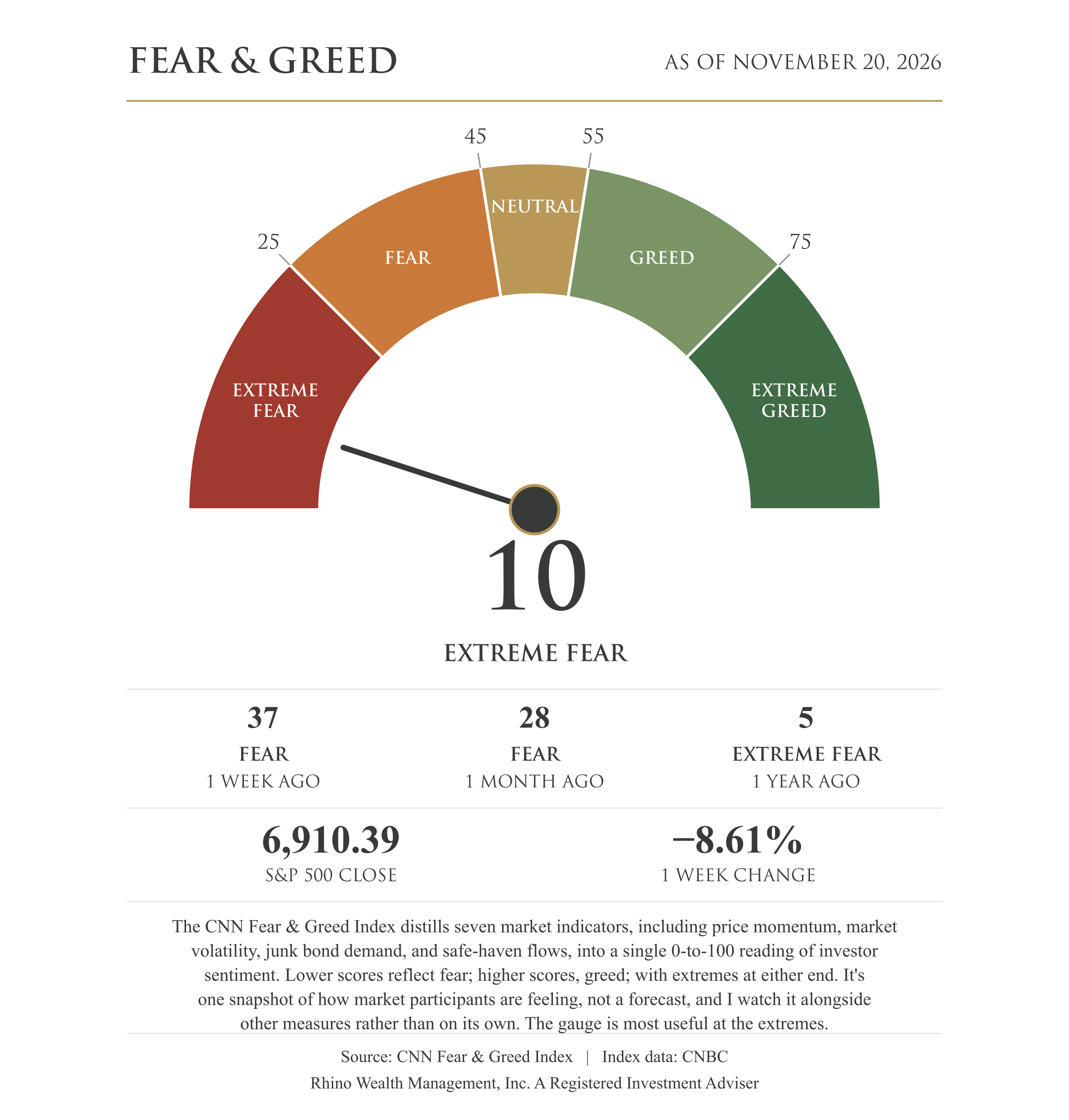
The S&P 500 finished the week down 8.6%, closing at 6,910 and putting the index in correction territory, meaning it has fallen 10% or more from a recent high. It's now at levels close to where we began the year. Corrections are painful, but outside of a recession they're a normal part of investing. Whether this one stays contained or turns into something deeper usually comes down to the economy. That's why I'm watching the economic data closely for any signs of weakness.
What Christmas Eve 2018 can tell us about today's market
On Christmas Eve 2018, the market closed early at 1 p.m., down sharply. The S&P 500 fell 2.7% to 2,351, its seventh loss in eight sessions and its worst Christmas Eve on record.
I was writing an unscheduled email to clients about the market's volatility and weakness. The S&P was down nearly 15% for December, on pace for its worst December on record, and almost 20% below its September high.
History doesn't repeat itself, but it often rhymes, and the similarities to today are worth a look. Donald Trump was president then, as he is now. In November 2018, Democrats won control of the House in the midterm elections. This month they won the House and the Senate. The Fed raised rates at its December 2018 meeting. This year it raised rates in September, its first hike in more than three years, and markets widely expect another at its Dec. 8–9 meeting.
The market's favorite stocks led the decline in both cases. In 2018 it was the FAANG stocks: Facebook, Amazon, Apple, Netflix and Google's parent, Alphabet. This time it's the companies tied to artificial intelligence, led by Nvidia.
December has a reputation as a good month for stocks. Since 1950, the S&P 500 has gained in December about 75% of the time, more often than in any other month. 2018 was an exception. The S&P lost 9.2% that December, its worst December since 1931.
The day after Christmas, the S&P rose 5%. By April 2019 it was back at a record high.
The Fed isn't done raising rates
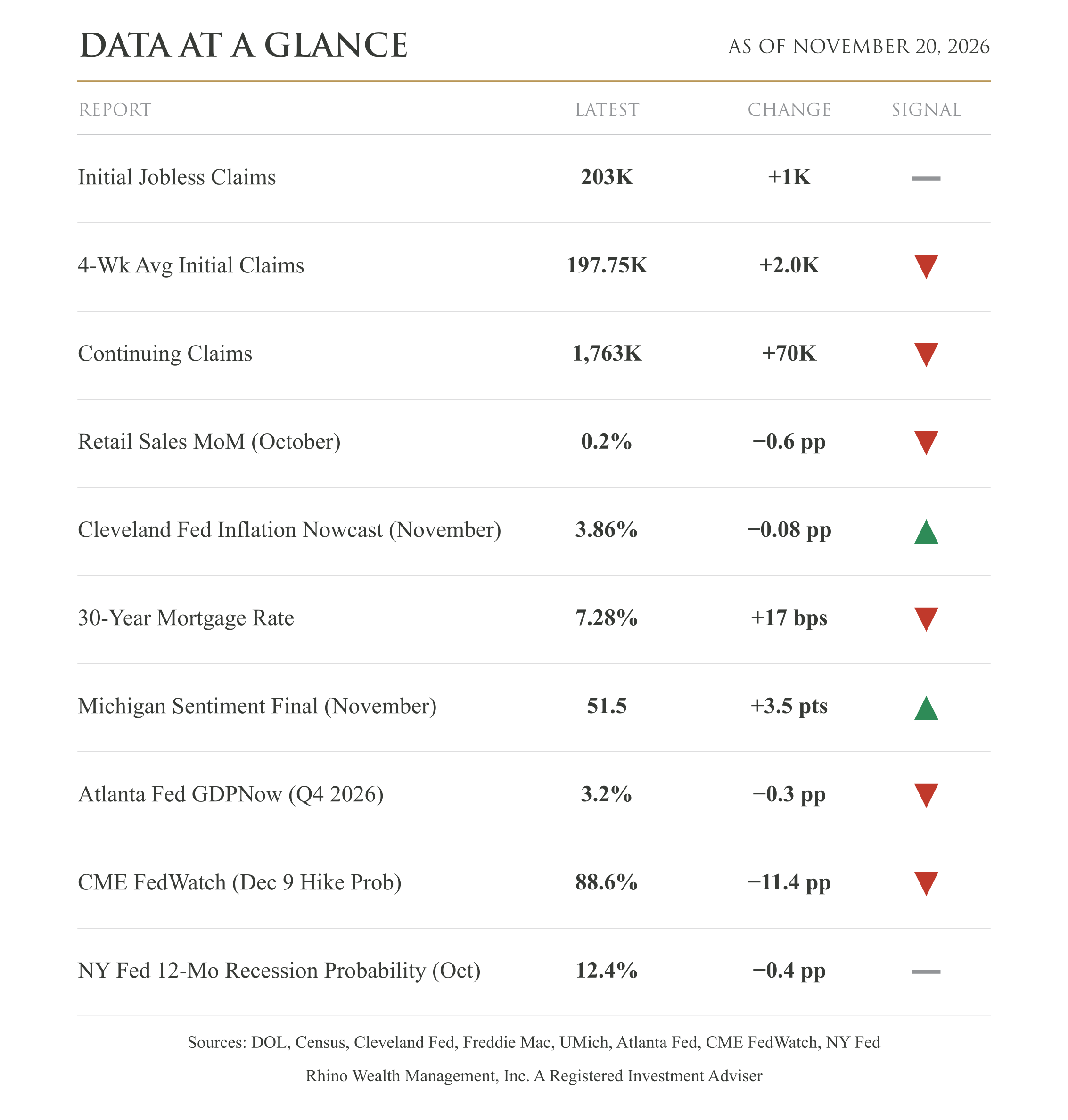
The Fed raised rates a quarter point in September and then held steady at its October meeting ahead of the midterm elections. Minutes from that meeting, released this week, showed almost all Fed officials expect further hikes to be appropriate. Markets are pricing an 89% chance of another quarter-point increase in December. Higher rates slow the economy by making it more expensive for households and businesses to borrow and spend, which brings down demand for goods and services. Historically, inflation has fallen as borrowing costs have risen. Elevated fuel prices have been one of the drivers of inflation this year. If prices at the pump trend lower, inflation may tick down and give the Fed room to move more slowly.
AI has been carrying the economy
Some of the increase in demand for capital, labor, materials, goods and services can be traced back to the buildout of AI infrastructure. By one estimate, AI accounts for roughly a third of US economic growth this year, and its reach goes well beyond technology companies. Building a data center takes carpenters, electricians, concrete crews and heavy equipment operators. The spending also runs up the supply chain to suppliers of machinery, power generation equipment and building materials. At the same time, investors are questioning whether AI will produce enough profit to justify what's being spent, and how that spending is being paid for. Some of the buildout is being financed with high-yield debt, and the Fed's latest minutes added AI-related debt to its list of financial stability risks.
The midterms put the AI buildout at risk
Democrats won control of both the House and Senate this month, along with a number of governor's races and state legislatures, and many of their candidates campaigned against data centers in response to public pushback on their development. In Congress, the party has already filed about a half-dozen bills to roll back data center tax breaks or tax AI, and has said AI taxation will be a priority. How much of that campaign rhetoric actually becomes law won't be clear until the new Congress takes office in January. President Trump still holds a veto, and the Senate filibuster means most major bills need 60 votes, so sweeping changes would require some Republican support. At the local level, voters approved bans or restrictions on new data centers in at least 29 jurisdictions. Whether it comes from a higher cost of capital or restrictive legislation, we should expect any headwind to data center development to have consequences across the economy and, as we're seeing, across markets.
Focusing on the fundamentals
More uncertainty often brings more volatility. This year may not follow the 2018 playbook, but that episode is a reminder that we've seen market weakness like this before. As Paul Harvey famously said, "In times like these, it helps to recall that there have always been times like these."
And in times like these, it's important to focus on the fundamentals:
Jobs: When people have jobs, they have income to spend on goods and services, and consumer spending drives around 70% of the economy. The unemployment rate is low, and claims for unemployment benefits are stable.
GDP: The economy is growing, with fourth-quarter GDP expected to come in around 3.2%.
Corporate earnings: Companies are reporting solid earnings, and growth is expected to continue.
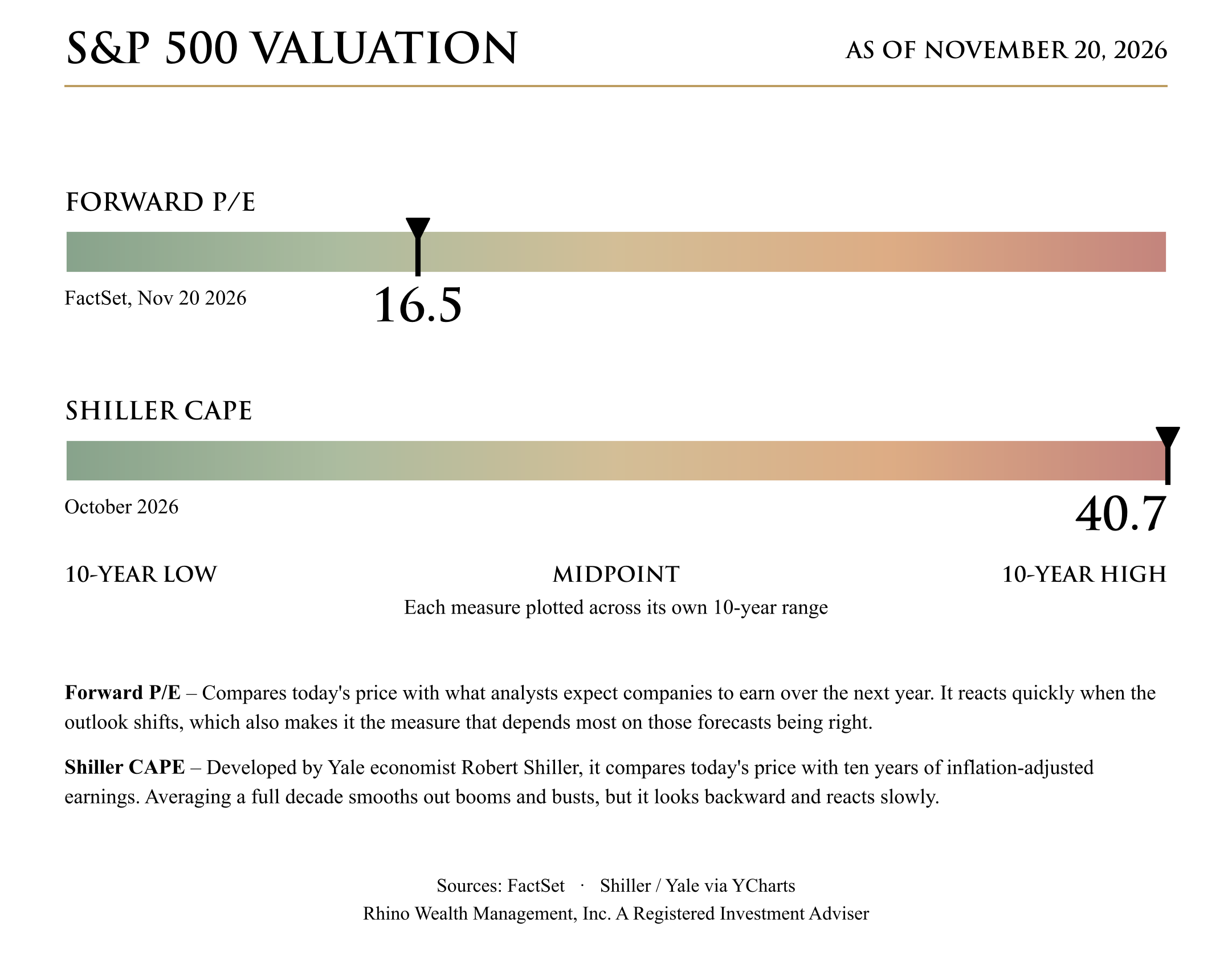
Valuations: The S&P 500 has been expensive for an extended period. If earnings expectations hold, it's now reasonably priced.
That doesn't mean there's nothing to worry about. There are genuine risks here, and I'm watching them closely:
Inflation and the Fed: whether inflation cools enough for the Fed to slow its pace of rate hikes.
The AI buildout: whether the spending and the debt behind it hold up, and how much of the campaign talk on data centers becomes law once the new Congress takes office in January.
What I'm watching next week:
On Wednesday, we'll get October's core PCE inflation, the Fed's preferred measure of inflation, which excludes food and energy. The same morning brings October personal income and spending, the second estimate of third-quarter GDP, and October durable goods orders, which track orders for long-lasting goods like machinery and equipment.
Disclosure:
This material is provided by Todd Van Der Meid, MBA, CFP®, through Rhino Wealth Management, Inc., a Registered Investment Adviser, solely for informational purposes. It is not intended as investment, tax, legal, or accounting advice. Investors should consult qualified professionals before making financial decisions.
Opinions expressed herein are general in nature and not tailored to individual circumstances. Investment strategies discussed may not be suitable for every investor. All investments carry risk, including possible loss of principal, and past performance does not guarantee future results. No investment strategy or risk management technique ensures profit or eliminates risk in all market conditions.
Investments in foreign or emerging markets involve additional risk, such as currency fluctuations, geopolitical instability, and varying accounting standards. Sector-specific investments can be more volatile due to their concentrated nature. References to indexes are for illustrative purposes; indexes are unmanaged, cannot be invested into directly, and their performance does not reflect fees, expenses, or sales charges. Index performance is not indicative of specific investment performance.
Economic forecasts and forward-looking statements reflect current views and assumptions and are subject to change. Actual results may vary materially due to market or other conditions. There is no obligation to update forward-looking information.
Information presented herein comes from reliable third-party sources but is not guaranteed for accuracy or completeness. Rhino Wealth Management, Inc. disclaims liability for errors or omissions. Portions of this content may be generated using advanced analytical tools, including artificial intelligence, and all such content has been reviewed and validated by Todd Van Der Meid, MBA, CFP®, using proprietary quality-control measures. Rhino Wealth Management, Inc. does not directly hold securities; however, securities mentioned may be included within recommended portfolio models or held by clients. Please refer to our Form ADV for additional details regarding potential conflicts of interest.