
The S&P 500 finished the holiday-shortened week up 5.6% as investors struggled with ongoing uncertainty around AI.
At almost any time, a scan of mainstream and social media could lead you to believe the economy is on the precipice of a recession and a stock market crash is inevitable. Yet since World War II, the economy has been in recession only about 15% of the time. Our edge is an unbiased review of the actual economic data, with the understanding that things that have never happened before are happening every day.
The economy is running hotter than economists expected, and the Fed is responding by raising the Fed Funds rate. This week the government revised third-quarter GDP up to a 4.3% annual rate from its first estimate of 3.4%, the fastest pace in three years. Inflation is heading the same direction: the Personal Consumption Expenditures (PCE) index, the Fed's preferred gauge, came in at 3.8% for October, up from 3.6% in September. With both growth and inflation picking up, the futures market now puts the odds of a quarter-point rate hike at the December 9 meeting at about 99%.
The risk is that the Fed tightens too much and slows the economy into recession. That's a real risk, but not a near-term one.
AI-related stocks swung hard again this week. The S&P 500 came into the week in a correction after falling 8.6% the week before, then rallied when Nvidia's board reinstated Jensen Huang as CEO following his resignation earlier this month.
The risk is that AI companies are now large enough that their swings can carry the whole index with them. AI infrastructure spending is such a large part of US economic growth that anything perceived as a threat to the AI story is enough to move the market. These events have also exposed how dangerously dependent the industry is on a handful of key people.
The administration proposed a new round of tariffs this week, aimed at 14 trading partners including China and the European Union.
The risk is that tariffs raise the prices of imported goods at a time when inflation is already moving in the wrong direction. Meanwhile, our government keeps running deficits and adding to the national debt at an unsustainable rate. That money has to come from somewhere, and taxing spending may be a better choice than raising income taxes. Tariffs are a tax on spending, and because they apply only to imported goods, they also give domestic producers an advantage.
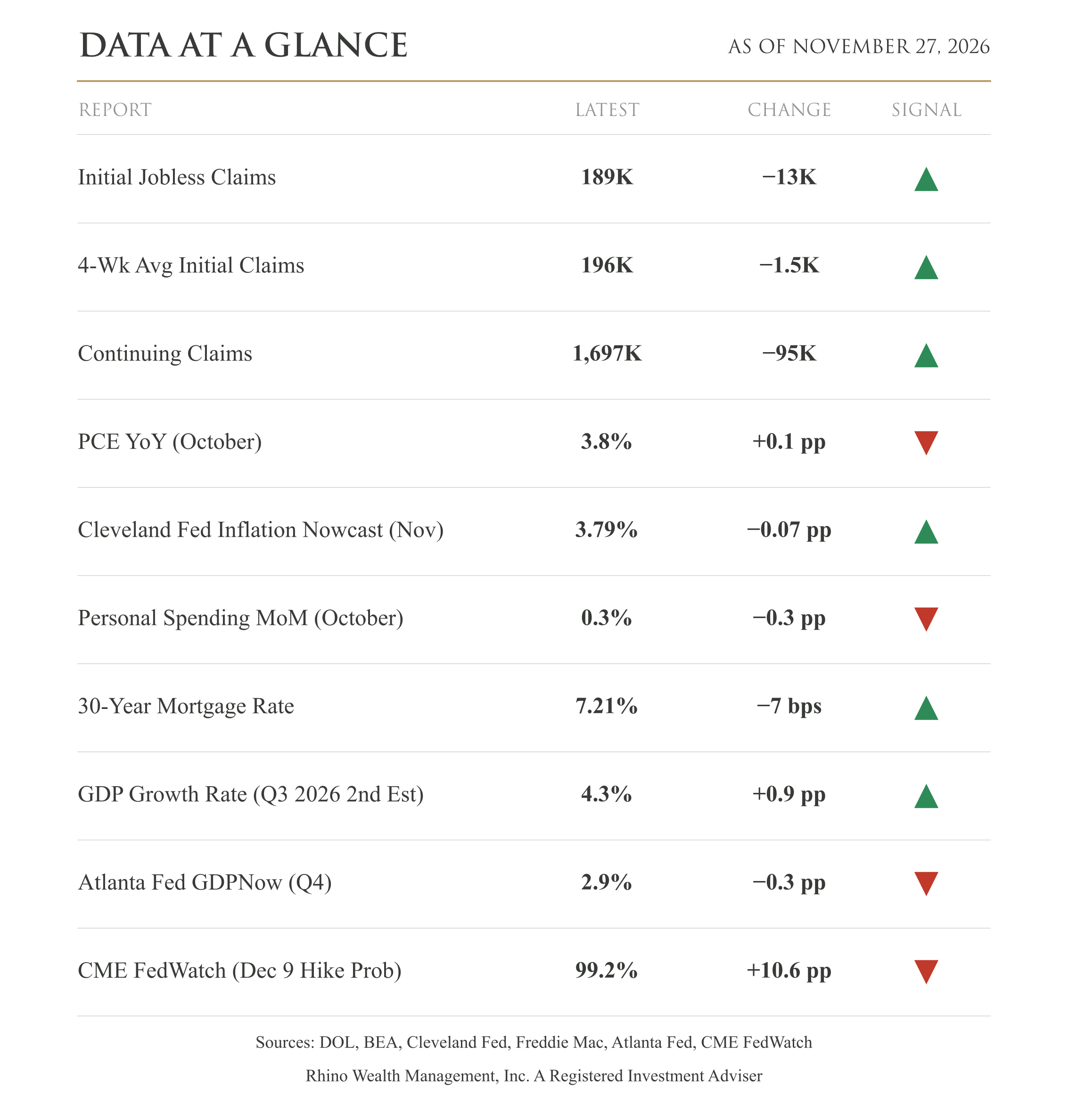
Claims fell and third-quarter growth was revised up to 4.3%, but PCE inflation rose for a third straight month to 3.8%, and futures now put the odds of a December rate hike at 99%.
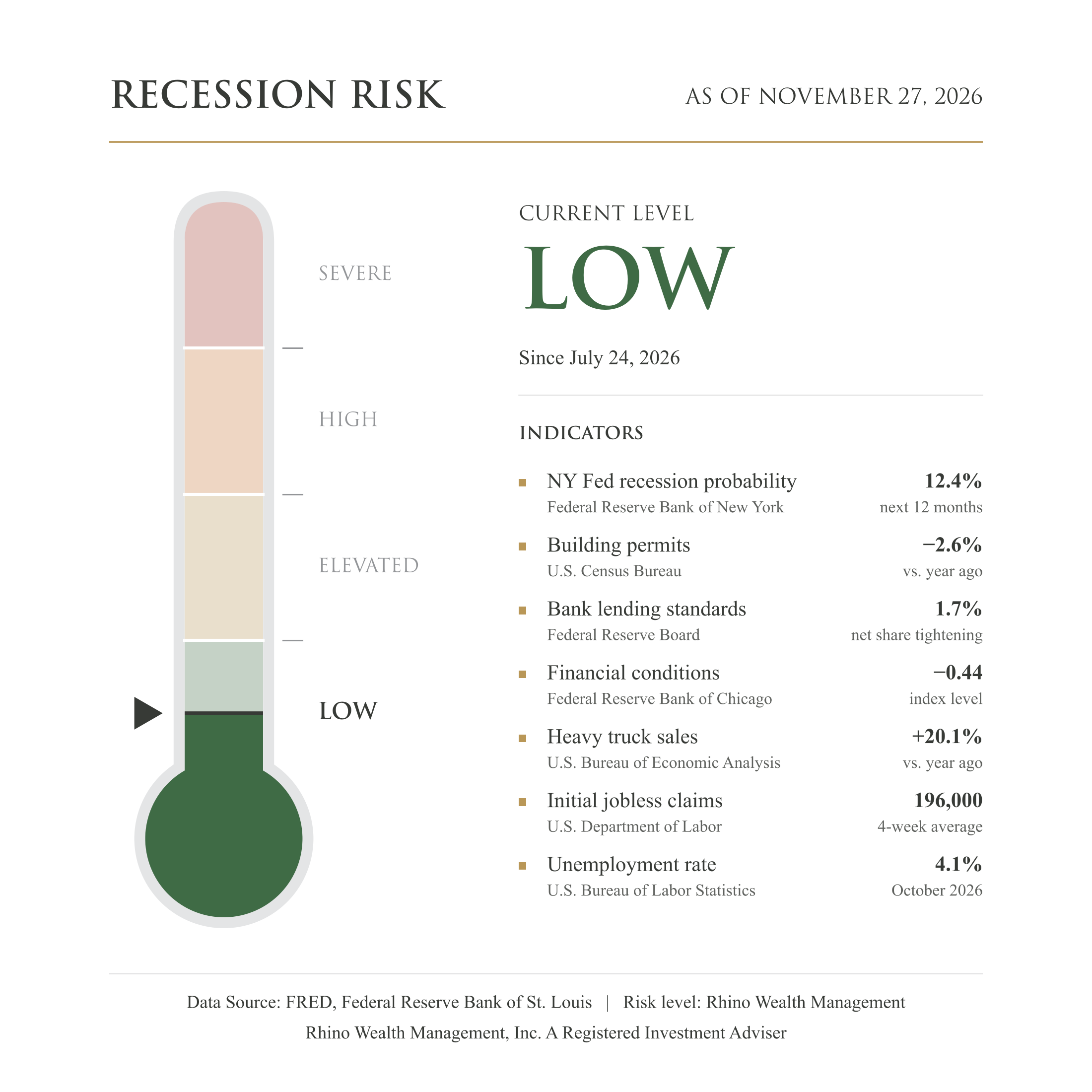
Our recession risk gauge reads Low. None of the seven indicators we track is signaling a downturn right now.
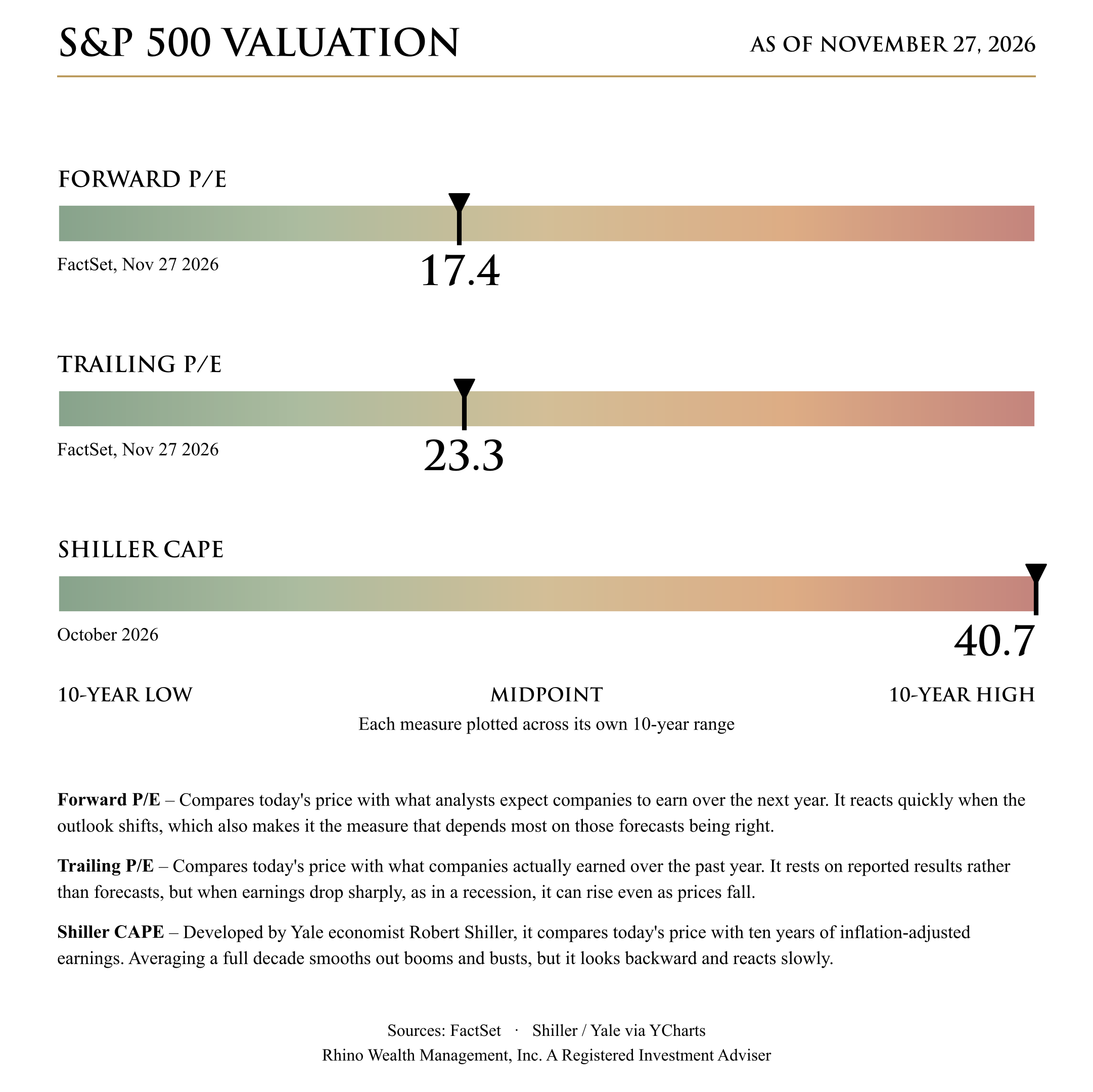
On the past year's earnings and the coming year's estimates, the S&P 500 looks reasonably valued, provided those estimates hold. The longer view is less comfortable: measured against a decade of earnings, prices are at a 10-year high.
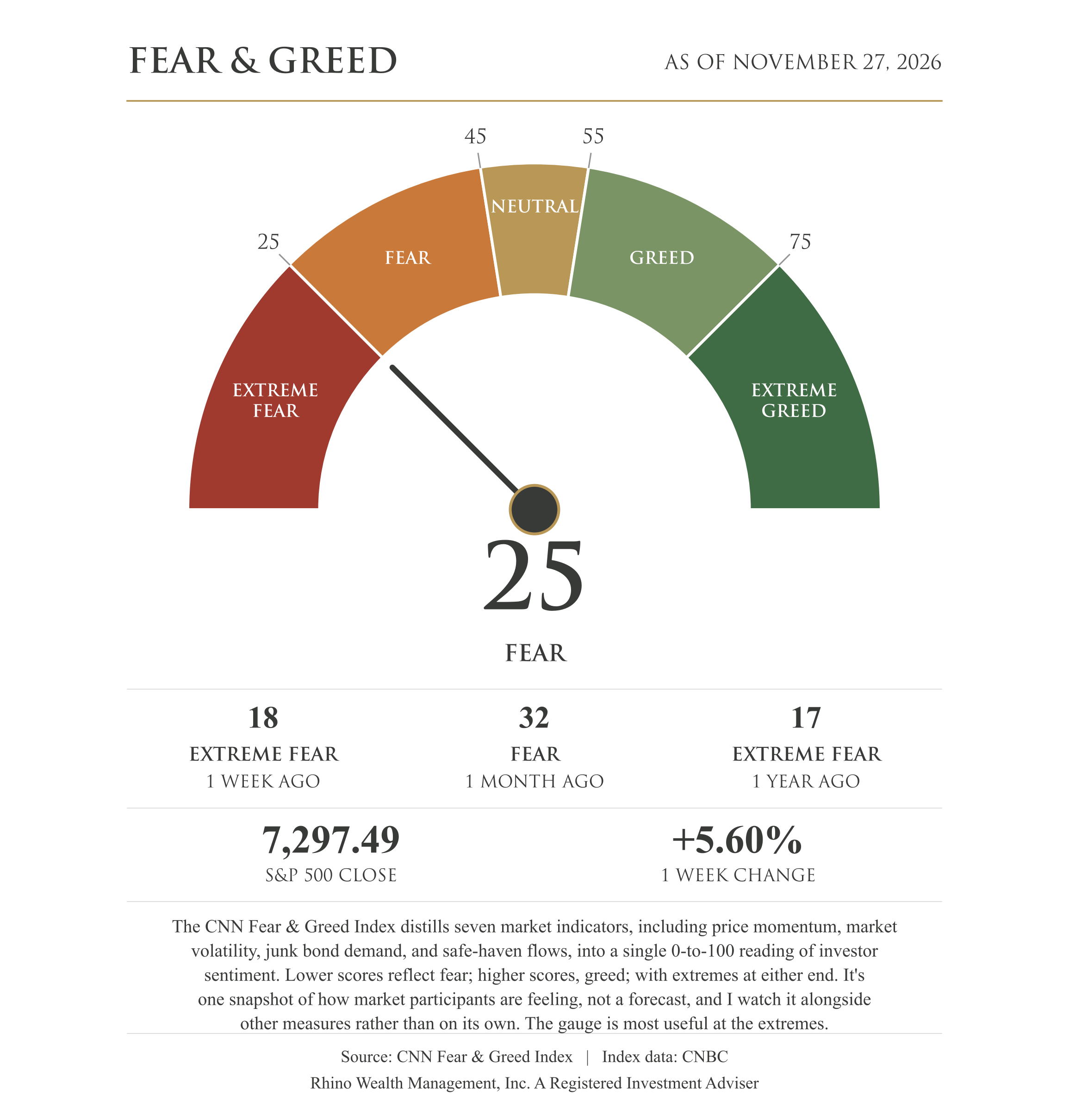
Even after a 5.6% gain for the S&P 500 this week, sentiment hasn't caught up. The Fear & Greed Index sits at 25, just above Extreme Fear. That's better than last week's 18, but investors are still treating this rally with caution and uncertainty.
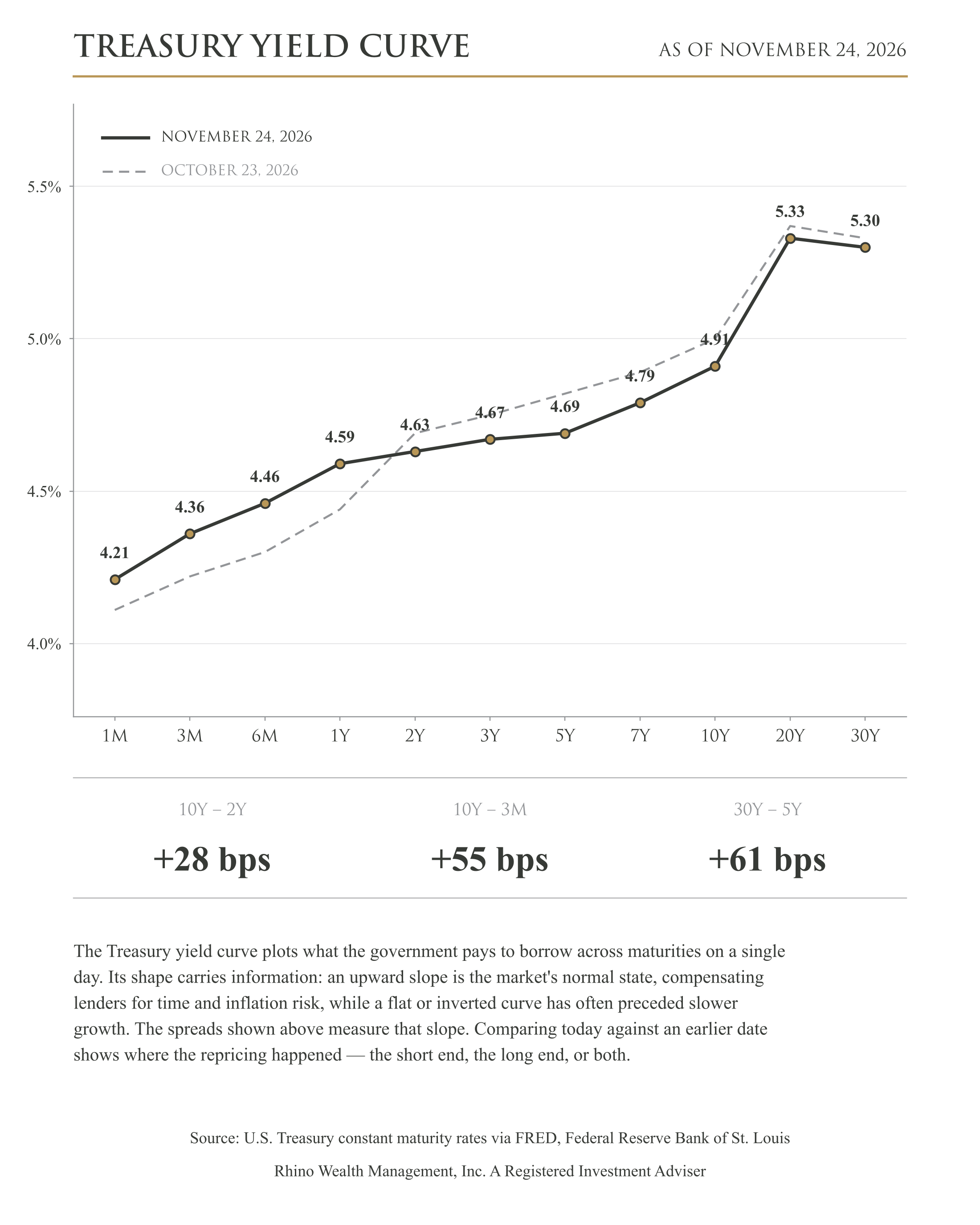
The yield curve still slopes upward, but it's flatter than a month ago. Short-term yields rose while the 2- to 10-year range fell. Its shape shows what the bond market expects for growth and Fed policy, and it feeds into what you earn on cash and pay on loans.
What I'm watching next week:
Friday's November jobs report, the last major data release before the Fed meets December 8–9, and Jensen Huang's closed-door interviews with three House committees on December 1, given how much the AI trade has moved on news about him.
Disclosure:
This material is provided by Todd Van Der Meid, MBA, CFP®, through Rhino Wealth Management, Inc., a Registered Investment Adviser, solely for informational purposes. It is not intended as investment, tax, legal, or accounting advice. Investors should consult qualified professionals before making financial decisions.
Opinions expressed herein are general in nature and not tailored to individual circumstances. Investment strategies discussed may not be suitable for every investor. All investments carry risk, including possible loss of principal, and past performance does not guarantee future results. No investment strategy or risk management technique ensures profit or eliminates risk in all market conditions.
Investments in foreign or emerging markets involve additional risk, such as currency fluctuations, geopolitical instability, and varying accounting standards. Sector-specific investments can be more volatile due to their concentrated nature. References to indexes are for illustrative purposes; indexes are unmanaged, cannot be invested into directly, and their performance does not reflect fees, expenses, or sales charges. Index performance is not indicative of specific investment performance.
Economic forecasts and forward-looking statements reflect current views and assumptions and are subject to change. Actual results may vary materially due to market or other conditions. There is no obligation to update forward-looking information.
Information presented herein comes from reliable third-party sources but is not guaranteed for accuracy or completeness. Rhino Wealth Management, Inc. disclaims liability for errors or omissions. Portions of this content may be generated using advanced analytical tools, including artificial intelligence, and all such content has been reviewed and validated by Todd Van Der Meid, MBA, CFP®, using proprietary quality-control measures. Rhino Wealth Management, Inc. does not directly hold securities; however, securities mentioned may be included within recommended portfolio models or held by clients. Please refer to our Form ADV for additional details regarding potential conflicts of interest.