
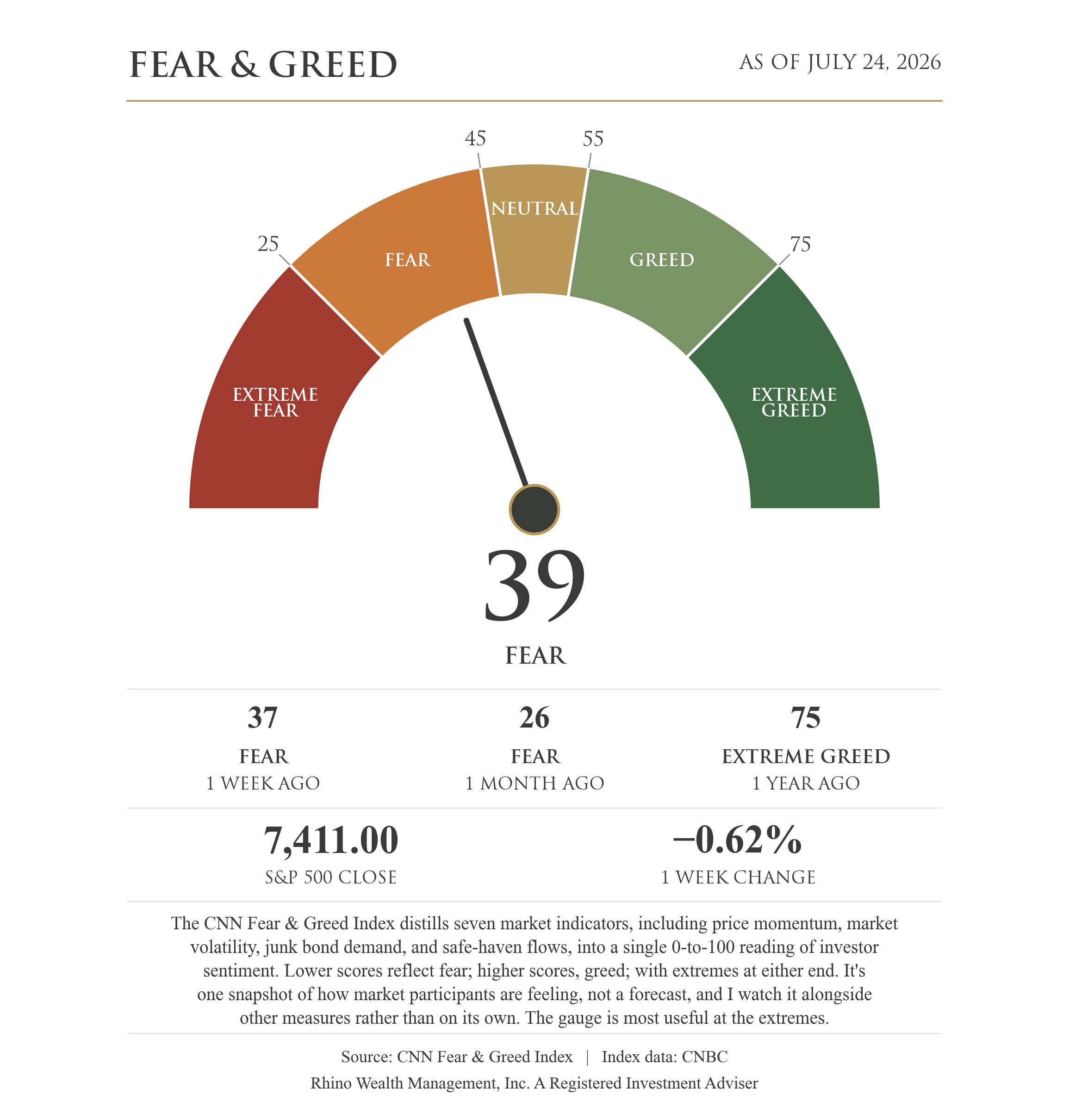
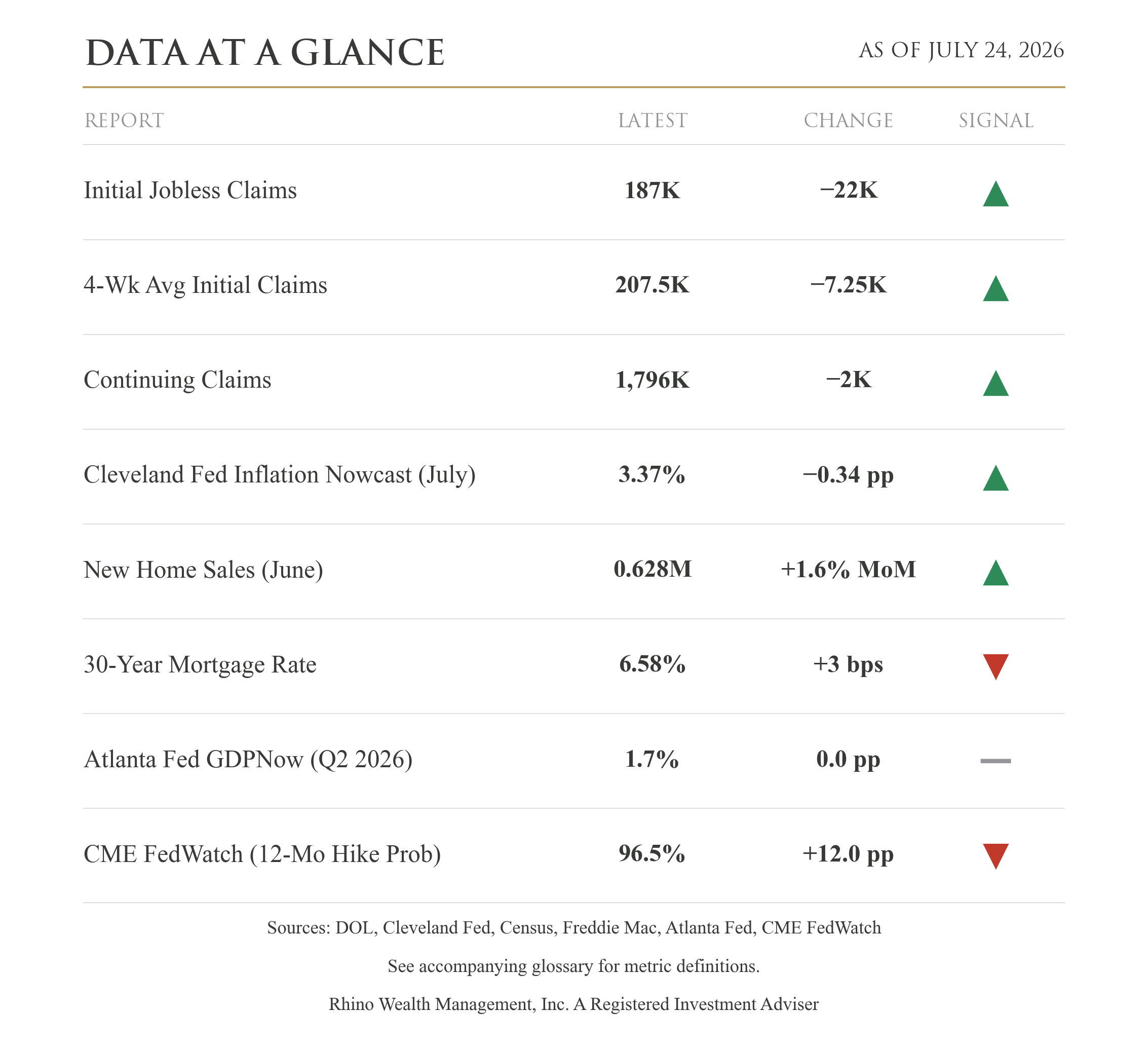
The S&P 500 fell 0.62% this week as investors weighed a strong economy against hot wars in two regions that briefly sent oil above $100 a barrel for the first time since May. The U.S. and Iran are exchanging strikes, with Iran and its proxies attacking tankers, while Russia and Ukraine trade missile and drone attacks, Ukraine reaching oil refineries deep inside Russia. At home, new claims for unemployment benefits fell to 187,000, the fewest since 1969.
Yemen's Iran-backed Houthis attacked two Saudi oil tankers in the Red Sea, and insurers can now cancel policies for tankers that pay Iran tolls to pass through the Strait of Hormuz, the channel that carries roughly a fifth of the world's oil. When insurance is in doubt, shipping slows down even if nothing else happens. Those refinery strikes in Russia have knocked out an estimated 20% to 40% of the country's oil-refining capacity, so both wars are squeezing the same commodity. West Texas crude rose about 8% this week to $89 a barrel, and Brent, the global benchmark, touched $100 Thursday before easing on reports that Pakistan is working to restart U.S.-Iran talks. Higher oil feeds into gas prices, shipping costs, and the inflation numbers the Fed watches.
The 10-year Treasury rose to 4.70% this week, its highest level since January of last year. That yield sets the price of borrowing across the economy: mortgages, car loans, and business credit all move with it. When it rises, existing bonds lose value and investors may become less willing to pay up for stocks. June's inflation report was better than feared, and hike odds rose anyway. The futures market now puts a 96.5% chance on at least one rate hike over the next 12 months. The Fed meets Wednesday, and energy is the swing factor in whether inflation will cool. The oil market just spent the week pricing in two wars.
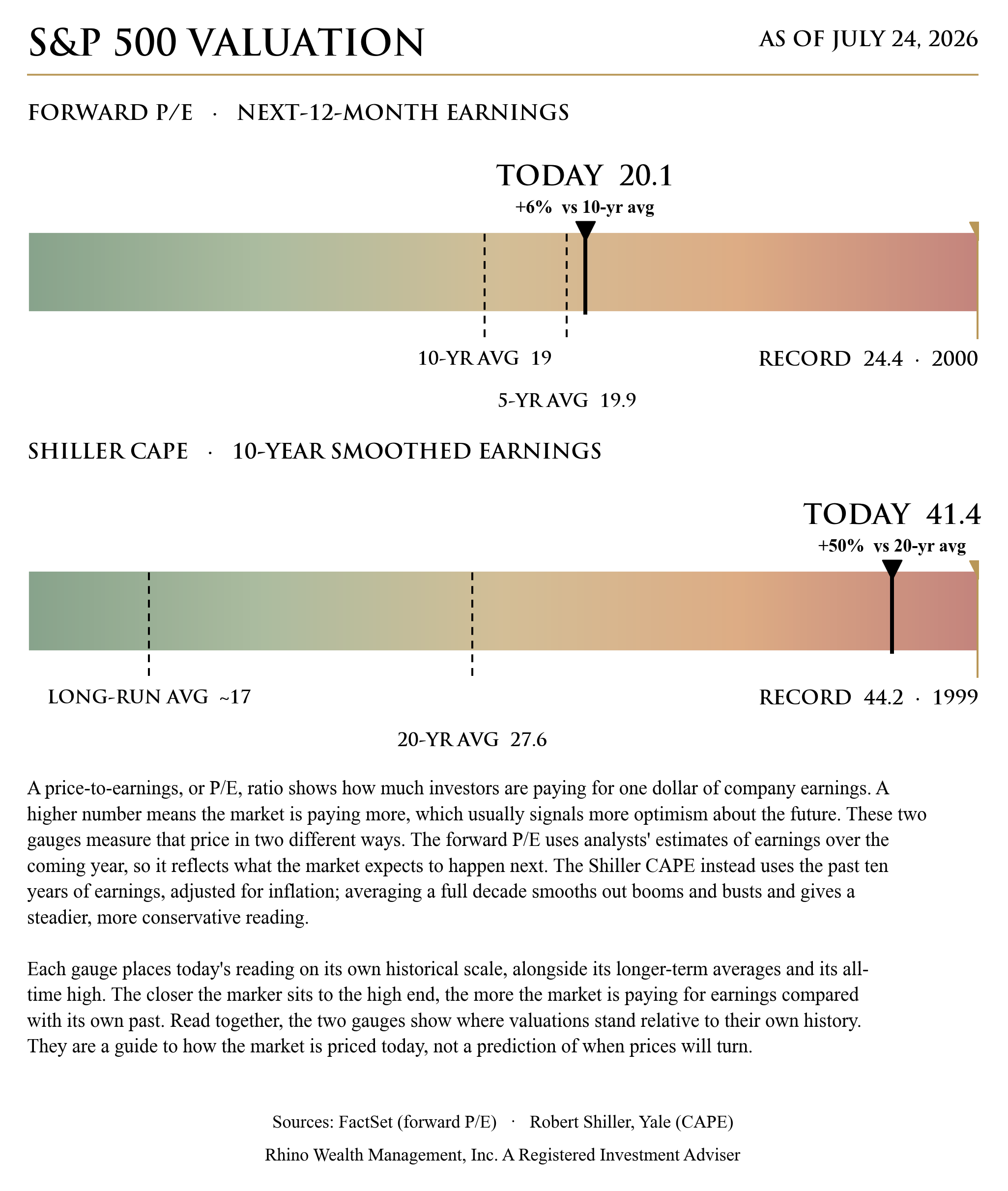
With layoffs this low, the Fed has little reason to worry that higher rates will cost people their jobs, which is why a strong jobs report argues for a rate hike rather than against one. The economy can absorb higher rates. Stock prices at 20 times next year's expected earnings are the part that may not.
New tariffs of 10% to 12.5% took effect Friday on 60 trading partners covering roughly 99% of what America imports. They replace a 10% tariff that expired the same day, so the change in what you pay is small, but the floor that was set to lapse is now permanent.
Two wars, oil over $100, and rising odds of a rate hike, and the market gave up less than one percent this week. The economy is still growing and still employing people. What I'm watching from here: whether the Pakistan-brokered talks with Iran are real or another stall for time. Oil gave back 3% Friday on that report alone, and a genuine negotiation would ease the inflation problem and the rate-hike odds with it. Thursday morning brings the two numbers that shape the Fed's next move: second-quarter gross domestic product (GDP), the broadest measure of how fast the economy grew, and the Personal Consumption Expenditures (PCE) index, the inflation gauge the Fed watches most closely. A cooling PCE reading would take the pressure off rates, while another hot one would put a hike back in play. As always, I'll do my best to keep you informed.
Glossary of Terms
Initial Jobless Claims — The number of people who filed for unemployment benefits for the first time last week. It's one of the timeliest reads on the job market: fewer claims means fewer layoffs. This week's 187,000 is among the lowest readings in years. Source: U.S. Department of Labor.
4-Week Average Initial Claims — The average of initial jobless claims over the past four weeks. Smoothing out the week-to-week noise gives a clearer picture of the underlying layoff trend. Source: U.S. Department of Labor.
Continuing Claims — The number of people still receiving unemployment benefits after their first week. It reflects how easily laid-off workers are finding new jobs — a lower number is better. Source: U.S. Department of Labor.
Cleveland Fed Inflation Nowcast (July) — A daily estimate of what July's Consumer Price Index (CPI) inflation will be, measured against a year earlier, before the official government figure is released. It gives an early sense of where inflation is heading; a falling estimate points to cooling prices. Source: Federal Reserve Bank of Cleveland.
New Home Sales (June) — The annualized pace of newly built single-family homes sold during June. A gauge of housing demand and buyer confidence; rising sales signal a healthier market. Source: U.S. Census Bureau (with HUD).
30-Year Mortgage Rate — The average interest rate on a 30-year fixed-rate home loan this week. It directly affects what buyers pay each month, so higher rates weigh on affordability. Source: Freddie Mac Primary Mortgage Market Survey.
Atlanta Fed GDPNow (Q2 2026) — A running estimate of how fast the economy (gross domestic product) is growing this quarter, updated as new data arrive. It offers a real-time read on growth ahead of the official government report. Source: Federal Reserve Bank of Atlanta.
CME FedWatch (12-Mo Hike Prob) — The market-implied probability that the Federal Reserve's benchmark interest rate will be higher one year from now than it is today, derived from fed funds futures prices. A rising figure means traders increasingly expect tighter policy ahead. (Technically, it is the probability that the target rate sits above today's range at the FOMC meeting nearest the 12-month mark — not a count of individual rate hikes.) Source: CME FedWatch Tool.
Disclosure:
This material is provided by Todd Van Der Meid, MBA, CFP®, through Rhino Wealth Management, Inc., a Registered Investment Adviser, solely for informational purposes. It is not intended as investment, tax, legal, or accounting advice. Investors should consult qualified professionals before making financial decisions.
Opinions expressed herein are general in nature and not tailored to individual circumstances. Investment strategies discussed may not be suitable for every investor. All investments carry risk, including possible loss of principal, and past performance does not guarantee future results. No investment strategy or risk management technique ensures profit or eliminates risk in all market conditions.
Investments in foreign or emerging markets involve additional risk, such as currency fluctuations, geopolitical instability, and varying accounting standards. Sector-specific investments can be more volatile due to their concentrated nature. References to indexes are for illustrative purposes; indexes are unmanaged, cannot be invested into directly, and their performance does not reflect fees, expenses, or sales charges. Index performance is not indicative of specific investment performance.
Economic forecasts and forward-looking statements reflect current views and assumptions and are subject to change. Actual results may vary materially due to market or other conditions. There is no obligation to update forward-looking information.
Information presented herein comes from reliable third-party sources but is not guaranteed for accuracy or completeness. Rhino Wealth Management, Inc. disclaims liability for errors or omissions. Portions of this content may be generated using advanced analytical tools, including artificial intelligence, and all such content has been reviewed and validated by Todd Van Der Meid, MBA, CFP®, using proprietary quality-control measures. Rhino Wealth Management, Inc. does not directly hold securities; however, securities mentioned may be included within recommended portfolio models or held by clients. Please refer to our Form ADV for additional details regarding potential conflicts of interest.