
Weak Jobs, Volatile Oil
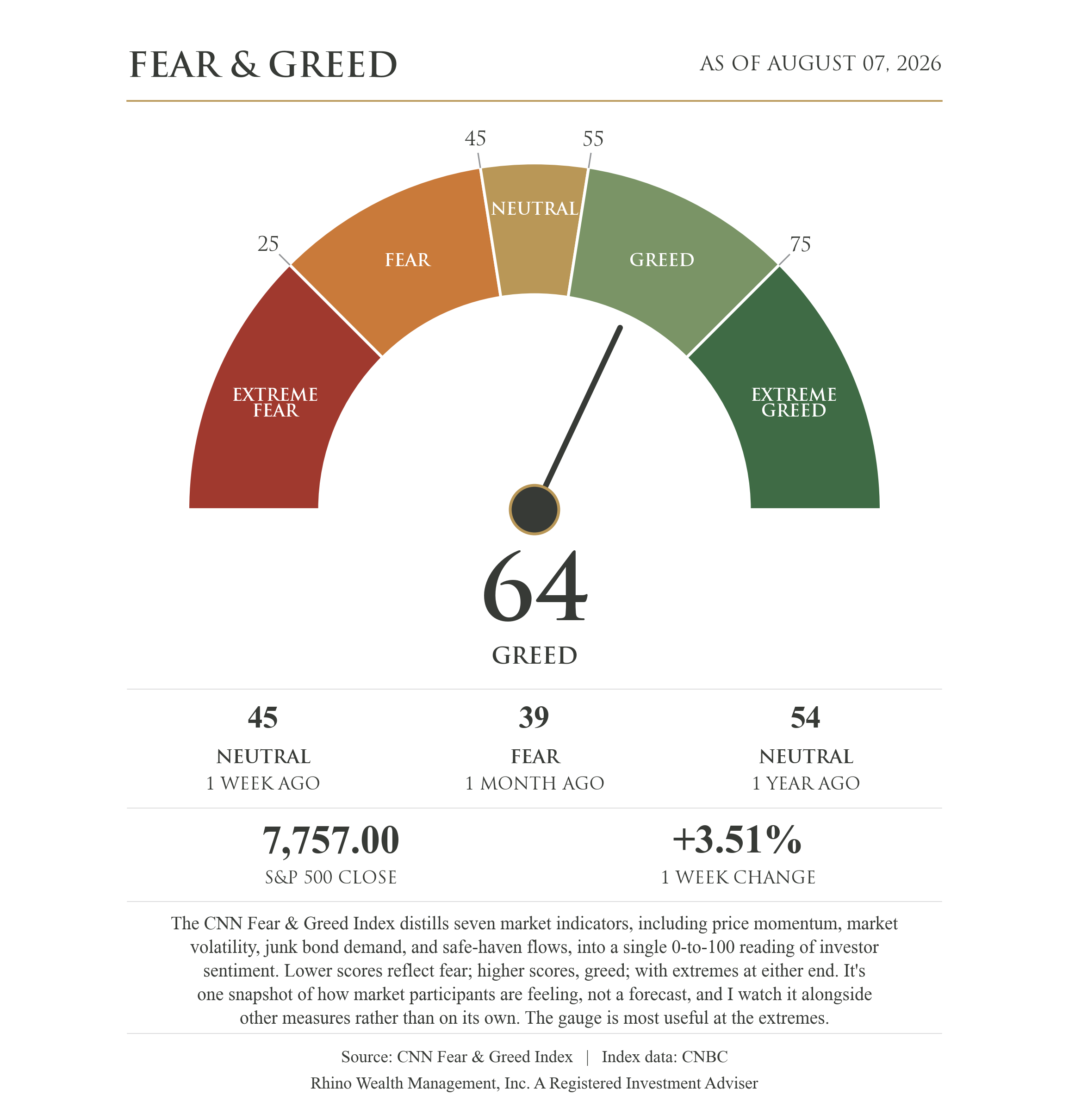
The S&P 500 closed the week 3.51%, helped along by a July jobs report that came in far weaker than expected. Oil had a rougher week, sliding to a multi-week low on hopes of a deal to reopen the Strait of Hormuz before reversing hard after Iran floated new restrictions on ship traffic through the waterway. It was an unusual mix: weaker labor data, strong manufacturing data, solid corporate earnings, and another round of geopolitical volatility in energy markets.
Payrolls and Wages
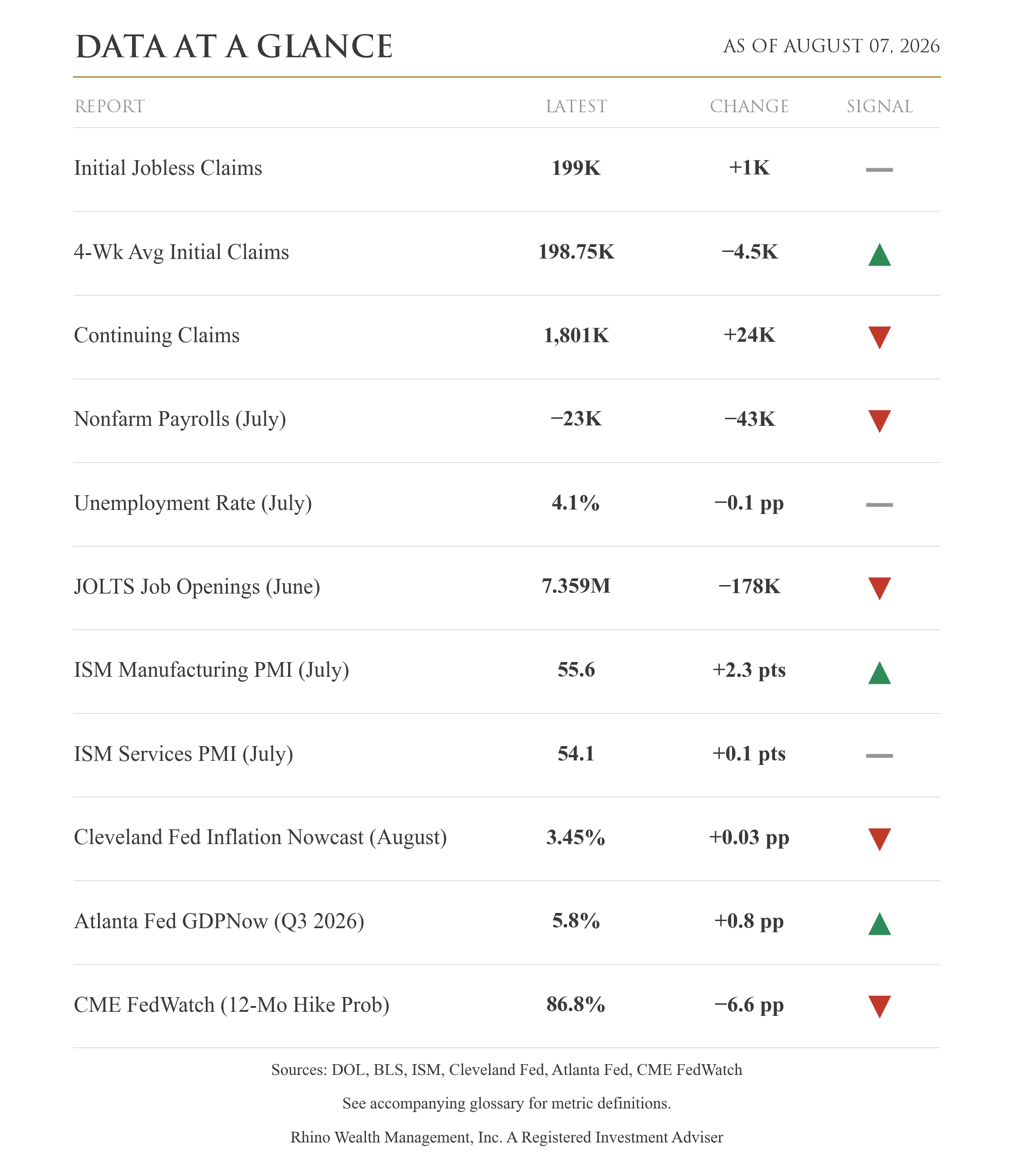
Non-farm payrolls fell 23,000 in July, versus a forecast for an 83,000 gain, and revisions erased another 103,000 jobs previously reported for May and June. The unemployment rate ticked down to 4.1%, but that came with fewer people participating in the labor force rather than a surge in hiring. Part of that decline is demographic. Baby boomers are retiring faster than younger, working-age adults are joining the workforce, which means the pool of available workers is naturally getting smaller. That makes the unemployment rate a little less useful on its own when judging the health of the labor market. Wage growth slowed to 3.2%, the weakest pace since May 2021. Slower hiring and wage growth take some of the pressure off the Fed to raise rates in September.
Oil and the Strait of Hormuz
West Texas Intermediate (WTI), the U.S. benchmark for crude oil, slid into the mid-$70s during the week on reports of a U.S.-brokered deal to reopen the Strait of Hormuz. It reversed hard after an Iranian parliamentary proposal sought to restrict which vessels could use the waterway. Brent moved back above $83 a barrel.
Manufacturing and Claims
The ISM Manufacturing Index jumped to its highest level in four years, corporate earnings have remained strong, and weekly jobless claims are still under 200,000. Hiring has clearly slowed. So far, though, that weakness hasn't spread broadly through the economy.
Reading the Weak Print
One weak employment report looks very different when manufacturing is expanding, companies are producing strong earnings, and layoffs remain low. Investors can read slower hiring as a reason for the Fed to hold rates steady rather than as evidence that the economy is falling into recession. That helps explain why both stocks and bonds rallied after such a poor jobs number.
The Fed's Complication
Oil is the complication for the Fed. A sustained move back toward $85 would add pressure to inflation at the same time the labor market is cooling. That would leave the Fed with weaker employment data arguing against higher rates and higher energy prices arguing in the other direction.
What's Next
Next week's Consumer Price Index (CPI), the government's broad measure of inflation paid by consumers, should give us a better look at how those forces are balancing out. What I'm watching from here is whether the weakness in hiring stays contained and whether oil can settle back down after another volatile week.
Glossary of Terms
Initial Jobless Claims (DOL): New unemployment benefit filings for the week. A rough real-time read on layoffs.
4-Wk Avg Initial Claims (DOL): Initial claims smoothed over four weeks to cut through weekly noise.
Continuing Claims (DOL): People still collecting unemployment benefits. Signals how quickly the unemployed are finding new jobs.
Nonfarm Payrolls (BLS): Net jobs added or lost across the economy, excluding farm work. The single most-watched labor market number.
Unemployment Rate (BLS): Share of the labor force that's jobless and actively looking for work.
JOLTS Job Openings (BLS): Total open positions employers are trying to fill. A gauge of labor demand.
ISM Manufacturing PMI (ISM): Survey of manufacturing purchasing managers. Above 50 signals expansion, below 50 contraction.
ISM Services PMI (ISM): Same survey concept, for the much larger services side of the economy.
Cleveland Fed Inflation Nowcast (Cleveland Fed): A same-day model estimate of current CPI inflation, ahead of the official BLS release.
Atlanta Fed GDPNow (Atlanta Fed): A running model estimate of current-quarter GDP growth, updated as new data arrives.
CME FedWatch (CME Group): Market-implied odds of the Fed's next rate move, derived from futures pricing.
Disclosure:
This material is provided by Todd Van Der Meid, MBA, CFP®, through Rhino Wealth Management, Inc., a Registered Investment Adviser, solely for informational purposes. It is not intended as investment, tax, legal, or accounting advice. Investors should consult qualified professionals before making financial decisions.
Opinions expressed herein are general in nature and not tailored to individual circumstances. Investment strategies discussed may not be suitable for every investor. All investments carry risk, including possible loss of principal, and past performance does not guarantee future results. No investment strategy or risk management technique ensures profit or eliminates risk in all market conditions.
Investments in foreign or emerging markets involve additional risk, such as currency fluctuations, geopolitical instability, and varying accounting standards. Sector-specific investments can be more volatile due to their concentrated nature. References to indexes are for illustrative purposes; indexes are unmanaged, cannot be invested into directly, and their performance does not reflect fees, expenses, or sales charges. Index performance is not indicative of specific investment performance.
Economic forecasts and forward-looking statements reflect current views and assumptions and are subject to change. Actual results may vary materially due to market or other conditions. There is no obligation to update forward-looking information.
Information presented herein comes from reliable third-party sources but is not guaranteed for accuracy or completeness. Rhino Wealth Management, Inc. disclaims liability for errors or omissions. Portions of this content may be generated using advanced analytical tools, including artificial intelligence, and all such content has been reviewed and validated by Todd Van Der Meid, MBA, CFP®, using proprietary quality-control measures. Rhino Wealth Management, Inc. does not directly hold securities; however, securities mentioned may be included within recommended portfolio models or held by clients. Please refer to our Form ADV for additional details regarding potential conflicts of interest.